

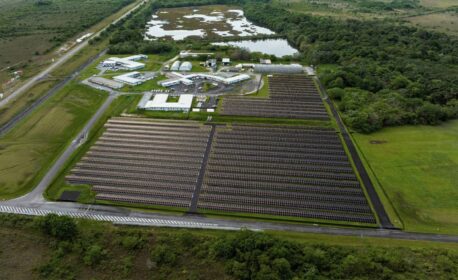
A technological feat: from photon to molecule
While the coupling of photovoltaic energy and hydrogen has been emerging in global heavy industry for several years, its application to the reliability requirements of the aerospace sector represents a true world first.
The process relies on a disruptive synergy where a 5.4 MWp solar power plant, composed of 10,800 Dualsun FLASH 500 panels installed on the ground, will generate a high-power direct current. This current will power a 1.25 MW electrolyzer, which will use the electricity to split water molecules (H2O) and extract low-carbon hydrogen, 100% renewable and locally sourced. Once liquefied and distributed to local uses (heavy and stationary transport), it will become the high-performance fuel essential for Ariane 6 engines, covering up to 15% of Arianegroup’s annual needs!
A precision infrastructure serving the region
This project, valued at over €40 million, is led by an elite consortium including ESA, CNES, Air Liquide Spatial Guyane, MT-Aerospace, BEBLUE, Alldis Nerius, and the universities of French Guiana and Brussels.
The facility will generate approximately 110 tons of low-carbon hydrogen annually on-site (including 62 tons for Ariane 6). Beyond its applications in the space sector, this technology directly supports local development: 45 tons per year will be allocated to heavy-duty land transport, and up to 5 tons can be dedicated to the region’s electricity needs.
This direct substitution of gray hydrogen with a decarbonized resource eliminates the emission of several thousand tons of CO2 per year!
A source of pride for Dualsun
For Dualsun, being featured on Europe’s spaceport goes far beyond commercial success. It will be recognition of our ability to operate in complex tropical environments and to transform every ray of sunshine into a concrete lever for technological progress. By making FLASH panels the energy engine for tomorrow’s space exploration, Dualsun is reaffirming its mission: to build environmental sovereignty, without compromise!
This project, led and funded by ESA and CNES, has received a grant from ADEME.
“Beyond climate observation, CNES is committed to a cleaner and more sustainable space. By developing innovative projects like HYGUANE, we are contributing to a responsible space industry, in line with current environmental challenges. Thanks to Dualsun panels, this initiative reduces the carbon footprint of the hydrogen needed for the Ariane 6 launcher.” Quentin Verdier, Energy Project Manager – CNES
“Great adventures are made of men, women, dreams, challenges to overcome, and teamwork. HYGUANE is all of these things at once: a collective project, a human adventure, technological challenges, and a new techno-economic framework in which space exploration is inextricably linked to its local environment. We are particularly pleased that, after four years of effort, the initial sketches on paper are becoming reality and that Dualsun is joining us on this journey at the crossroads of industry and the environment. A few photons transformed by Dualsun, water, and soon Ariane 6 on its launch pad powered by “Amazonian low-carbon fuel”—quite a symbol!” – Teddy Peponnet, HYGUANE Project Director – ESA.


